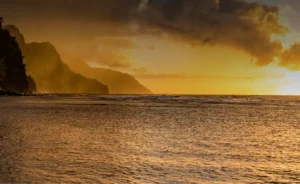
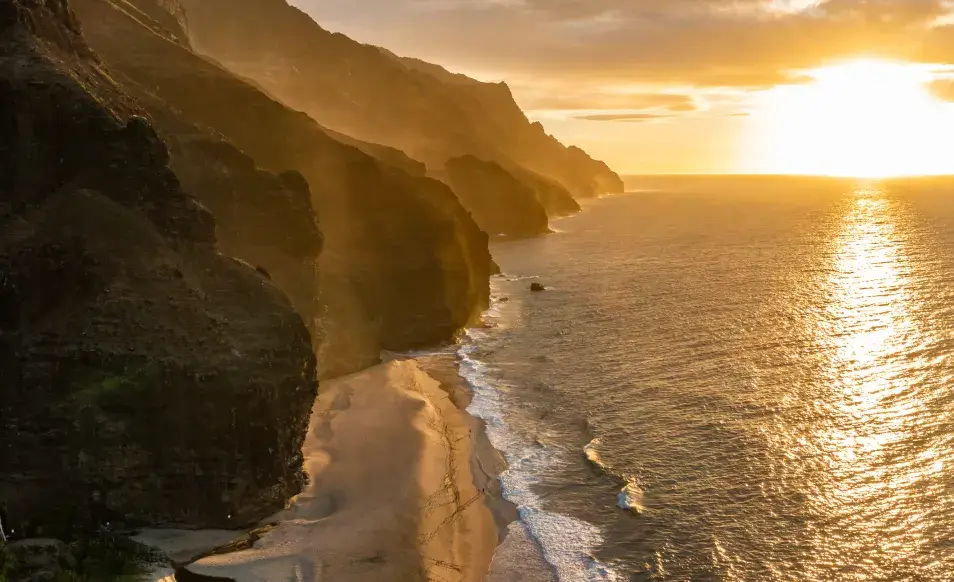
The Na Pali Coast faces west. That means the cliff walls are side-lit at golden hour, the caves fill with warm low-angle light, and the Honopū Arch frames the sun descending toward the water.
If you’re on a boat with a 360-degree walk-around deck, departing from the harbor closest to the coast, you’re positioned for the window. If you’re on a large catamaran from Port Allen with 49 passengers and a fixed bench section, you’re working around it.
Makana is a Native Hawaiian family-owned operation. Our family has been sailing these waters for over 200 years. The Na Pali Kai III is the right boat for this tour.
What Does the Na Pali Coast Look Like at Golden Hour?
The Na Pali Coast runs along Kauai’s northwest shore. The cliffs face west, which means afternoon and evening light hits them directly rather than from above.
That’s the difference between midday light, which flattens the green and washes out the texture, and golden-hour light, which pulls out the ridgelines, deepens the shadows inside the valleys, and turns the cliff walls amber.
Why the West-Facing Cliffs Change the Shot
West-facing cliffs at golden hour are front-lit. The sun drops toward the water at the same angle it illuminates the cliff face, which means you’re shooting into warm direct light rather than against a backlit silhouette.
The texture that midday overhead light misses — the fluted grooves in the volcanic rock, the shadow lines between ridges, the vegetation contrast — comes forward in the late afternoon. Kalalau Valley’s waterfall catches the last light in the fading sky above a valley already in shadow. That’s the shot.
The Golden-Hour Window — How Long You Have
Golden hour begins roughly an hour before sunset and lasts until the sun drops below the western horizon over the water. On the Na Pali Coast, that window is approximately 45–75 minutes depending on the season.
A boat that spends 30–45 minutes in transit from Port Allen arrives at the coast as the window is already open. A boat leaving from Kikiaola Harbor is on the cliffs before the light starts working.
Why the 360-Degree Deck Changes What You Can Shoot
The Na Pali Kai III has a 360-degree walk-around deck — a full-perimeter path around the catamaran that lets you move freely to either side, to the bow, and to the stern without asking anyone to shift. On a standard tour boat with fixed sections, your shooting position is wherever your seat happens to be.
On the Na Pali Coast, the cave entrance is on the port side as you move up the coast, and the cliff face catching color is to starboard. The Honopū Arch comes in from the bow angle. When the boat repositions near a cave, the light at the cave mouth shifts within seconds. With a 360-degree deck, you cover both. Without one, you pick one side and stay there.
Photographers specifically book the Na Pali Kai III because of this configuration. It’s the only boat in the Makana fleet with full perimeter access.
Sea Cave Access at Sunset
The sea caves on this stretch of coast can be entered when ocean conditions allow. Swell height and surge both factor in, and our captains have been reading these conditions their entire lives.
Pirates Cave Light at Golden Hour
Pirates Cave, known in Hawaiian as Waiahuakua, is the largest of the Na Pali sea caves — big enough for the Na Pali Kai III to enter when the ocean cooperates. The interior goes dark as the boat passes the cave mouth. Then light reenters from the far side.
At golden hour, the angle of the sun on the approach changes the quality of that reentry light. On a mid-morning tour, the far opening illuminates white water and rock. In the late afternoon, the same opening channels warm, low-angle light into the cave interior. The cave walls catch color that isn’t there at other times of day.
Rainbow Falls — Interior Light From a Different Source
Rainbow Falls is the second enclosed cave on this section of the coast. It is smaller than Pirates Cave, and the light behaves differently inside it.
The name comes from the refraction effect that forms under the right conditions — mist at the opening bends the sunlight into a visible color spectrum inside the cave walls. This is the cave whose name itself describes a photographic event.
The Honopū Arch — Framing and Timing
The Honopū Arch is a natural rock arch separating two beaches with no road or trail access. Film crews returned to it repeatedly — King Kong, James Bond, Pirates of the Caribbean. At golden hour, the arch frames the sun descending toward the water behind it. The arch itself is in shadow by the time the light hits the horizon, which gives the shot a foreground frame with a lit background.
It is not a sea cave. The top is open to the sky. Confusing it with an enclosed cave changes how you set up for the shot.
Why Departure Point Is a Photography Decision
Kikiaola Small Boat Harbor is on Kauai’s west side, the closest departure point to the Na Pali Coast on the island. Port Allen, where most tour operators on Kauai depart, sits farther south on the south shore. The transit difference is roughly 30–45 minutes each direction.
On a sunset cruise, that difference is not incidental. The golden-hour window is fixed. A boat that spends an extra hour in transit reaches the caves as the light is already fading, or turns back before the color peaks. We are already positioned close to the coast when the light starts working those cliff walls.
What to Bring for Coastal Photography
The Na Pali Coast is a marine environment. Spray is part of the experience, especially near the cave mouths and on the return leg in any wind.
Protect your gear with a waterproof housing or a dry bag rated for immersion. Camera bags that claim “water resistance” are not the same — assume the deck will be wet.
Bring a wide lens for the cliff faces, the Honopū Arch, and the cave openings. A telephoto helps with cave interior details and wildlife along the shore. You will be on the water for 4.5–5 hours, and the battery situation matters — bring a spare or a power bank.
After the sun goes down, the temperature on the water drops. Bring a warm layer for the return leg.
Book the Kauai Sunset Cruise
Makana Charters has earned more than 10,000 five-star reviews running Na Pali Coast tours from Kikiaola Harbor — verify before publishing. Tickets for the Na Pali Kai III are $199 per adult and $169 per child. Minimum age is 4 years old.
Call (808) 338-9980 to book. The team is available daily from 7 AM to 9 PM.
We depart from Kikiaola Small Boat Harbor in Kekaha on the west side of Kauai. Confirm the departure point when you book — it’s not Port Allen.
Frequently Asked Questions About the Kauai Sunset Cruise for Photographers
Which boat has the 360-degree walk-around deck?
The Na Pali Kai III. It’s the only boat in the Makana fleet with full perimeter access. When you book, specify that you want the Na Pali Kai III — not all sunset cruise boats are the same.
Can you photograph inside the Na Pali sea caves?
Yes, when ocean conditions allow entry. Pirates Cave and Rainbow Falls are both accessible in cooperative conditions. The interior of Pirates Cave fills with warm, low-angle light at golden hour that isn’t present at other times of day. Cave entry is never guaranteed — the captain makes the call on the water based on swell and surge.
Does departure harbor affect how much golden-hour time I get on the coast?
Yes. A boat leaving from Port Allen spends 30–60 minutes in transit to reach the Na Pali cliffs. Kikiaola Harbor is the closest departure point to the coast on Kauai. That transit difference determines whether you’re on the coast during the golden-hour window or still motoring toward it.
Is the Na Pali Kai III appropriate for photographers traveling solo or as a couple?
Yes. The Na Pali Kai III carries up to 32 guests on a shared tour. The 360-degree deck means you’re not anchored to a fixed position regardless of who’s around you. If you want the boat entirely to your group, learn about our private charter options or ask when you call.